Evaluating the Mindfulness Workbook for Kids: A Practical Resource for SEL and Self-Regulation
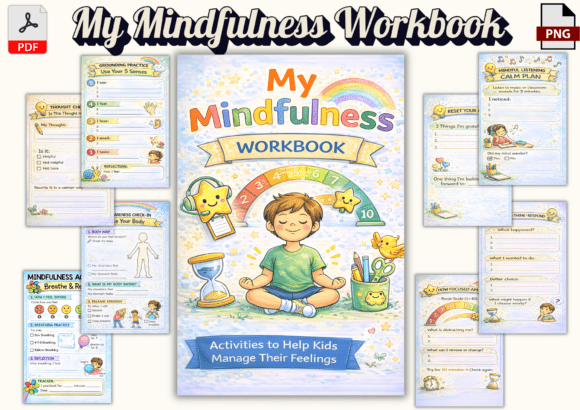
In an educational landscape increasingly focused on Social Emotional Learning (SEL), educators, school counselors, and parents are constantly seeking reliable tools to help students navigate emotional challenges. The Mindfulness Workbook for Kids, specifically designed for Grades 3–7, emerges as a targeted resource addressing this need. This 16-page printable PDF and PNG package offers a structured approach to teaching self-regulation, focusing on practical skills rather than abstract theory. For professionals looking to integrate mindfulness into their workflows—whether in a classroom setting, a therapy office, or a homeschool environment—understanding the utility and limitations of such digital assets is crucial.
Core Purpose and Target Audience
The primary objective of the Mindfulness Workbook for Kids Self-Regulation SEL Activities is to provide children with tangible strategies to manage their emotions and responses to daily stressors. Designed for students in upper elementary and middle school grades, the content acknowledges that older children require more sophisticated coping mechanisms than younger peers who might benefit from simple breathing exercises. The workbook targets specific developmental needs, including:
- Emotional Regulation: Helping students identify and modulate intense feelings.
- Focus and Attention: Enhancing concentration through mindful practices.
- Positive Self-Talk: Replacing negative internal narratives with constructive thoughts.
- Calm-Down Strategies: Providing immediate, actionable techniques for de-escalation.
- Self-Awareness: Encouraging reflection on personal triggers and responses.
This focus makes it particularly relevant for school counselors managing group sessions, teachers integrating SEL into morning meetings, and therapists supplementing clinical work with homework assignments. The vertical 6x9 inch format is also strategically chosen, mimicking traditional workbooks that feel familiar and professional to students, thereby increasing engagement compared to standard letter-sized sheets.
Structural Analysis and Content Breakdown
A thorough evaluation of the Mindfulness Workbook for Kids reveals a comprehensive suite of activities designed to cover various aspects of mental well-being. The inclusion of both high-resolution PDF files and individual PNG images offers flexibility for different use cases. Educators can print entire pages for physical distribution, while digital creators or therapists using tablets may utilize the PNGs for interactive whiteboard presentations or digital note-taking apps.
Key Components Inside the Workbook
The 16-page structure is not merely a collection of random exercises but a curated sequence of interventions. Key components include:
- Mindful Breathing Tracker: A foundational tool for establishing routine awareness of breath patterns.
- Body Scan Awareness: Guides students to connect physical sensations with emotional states, a critical skill for recognizing early signs of anxiety.
- Emotion Thermometer: A visual aid for quantifying intensity, helping students articulate how they feel before acting out.
- 5-4-3-2-1 Grounding Exercise: A widely recognized technique for managing panic or dissociation, presented here in a child-friendly format.
- Thought Catcher Worksheet: Introduces cognitive behavioral concepts by encouraging students to identify and challenge unhelpful thoughts.
- Calm Down Plan Builder: Promotes proactive planning, allowing students to decide in advance what strategies work best for them.
- Mindful Listening Activity: Sharpens auditory focus and present-moment awareness.
- Gratitude Reset Page: Shifts perspective toward positive reinforcement and appreciation.
- Pause • Think • Respond: Reinforces the gap between stimulus and reaction, a core component of impulse control.
- Kind Self-Talk Builder: Directly addresses the internal dialogue that often fuels low self-esteem or frustration.
- Focus Meter: Helps students monitor their attention levels during tasks.
- Mindful Movement Break: Acknowledges the link between physical activity and mental clarity.
- Safe Space Visualization: Uses imagery to create a mental refuge for stress relief.
- Weekly Reflection Page: Encourages long-term tracking of progress and consistency.
The inclusion of student reflection prompts and teacher comment spaces adds a layer of accountability and feedback, which is essential for measuring effectiveness in educational settings.
Design Quality and Usability
Visual design plays a significant role in the adoption of any student-facing material. The Mindfulness Workbook for Kids utilizes soft pastel illustrations, which serve a dual purpose: they are aesthetically pleasing to the target demographic without being overstimulating. In environments where students may already be anxious or overwhelmed, calming colors can subconsciously reinforce the theme of relaxation.
The 6x9-inch layout is particularly noteworthy. Many digital resources default to standard US Letter or A4 sizes, which can feel impersonal or cumbersome when bound or held. By adopting a smaller, book-like dimension, the creator signals an intent to produce a polished, professional product. This format is easier for small hands to manage and fits well into backpacks or counselor’s clipboards.
From a technical standpoint, providing both PDF and PNG formats enhances versatility. The PDF ensures consistent printing quality across different devices, while the PNG files allow for easy insertion into slide decks, newsletters, or digital platforms like Google Classroom. This flexibility reduces friction for busy educators who may need to adapt materials for hybrid learning environments.
Practical Application and Real-World Performance
When evaluating the practical value of the Mindfulness Workbook for Kids, it is important to consider how it performs in real-world scenarios. In a classroom setting, these pages can serve as quick "brain breaks" between lessons. The brevity of each activity—typically fitting on one page—allows teachers to implement them without disrupting the entire day’s schedule. For instance, the 5-4-3-2-1 Grounding Exercise can be completed in under five minutes, making it ideal for transition periods.
For school counselors, the workbook provides a structured framework for small group sessions. Instead of improvising activities, counselors can rely on the consistent quality of the worksheets to guide discussions on topics like anger management or social anxiety. The Thought Catcher Worksheet and Kind Self-Talk Builder are particularly effective for cognitive-behavioral interventions, offering a scaffolded approach to changing thought patterns.
Homeschool families and parents may find the Mindfulness Workbook for Kids useful for establishing evening routines or managing sibling conflicts. The Calm Down Plan Builder empowers children to take ownership of their emotional responses, fostering independence. However, success in these contexts depends on adult facilitation. Parents must model the behaviors described in the workbook; otherwise, the exercises may feel like chores rather than helpful tools.
Limitations and Considerations
While the Mindfulness Workbook for Kids offers substantial benefits, it is not a standalone solution for severe mental health issues. It is designed as a preventative and supportive tool, not a replacement for professional therapy. Educators should be aware that some students may struggle with certain activities, such as visualization or body scans, if they have experienced trauma. In such cases, gentle modification or alternative grounding techniques may be necessary.
Additionally, the static nature of printable worksheets means that once printed, they cannot be easily updated. If new research suggests more effective mindfulness practices, users would need to acquire updated versions. Furthermore, the reliance on self-reflection requires a certain level of literacy and introspective ability. Younger students within the Grade 3 range might need additional support to fully engage with written prompts.
Who Should Use This Resource?
The Mindfulness Workbook for Kids is best suited for:
- Classroom Teachers: Looking for ready-to-use SEL activities that align with curriculum standards.
- School Counselors: Seeking structured materials for individual or group counseling sessions.
- Special Education Professionals: Who need adaptable tools for students with varying emotional regulation needs.
- Homeschool Parents: Desiring to incorporate mental wellness into their daily educational routine.
- Therapists: Who want to assign homework that reinforces session topics.
It is less suitable for those seeking deep, theoretical exploration of mindfulness philosophy or for very young children (pre-K to Grade 2) who may require more play-based approaches. It is also not intended for crisis intervention.
Conclusion
The Mindfulness Workbook for Kids Self-Regulation SEL Activities represents a thoughtful, well-designed resource for supporting emotional development in Grades 3–7. Its strength lies in its practicality, combining evidence-based techniques with accessible, visually appealing formats. By offering both PDF and PNG options, it accommodates diverse teaching styles and technological setups. While it has limitations regarding depth and applicability to severe psychological conditions, it serves as an excellent foundation for building resilience, focus, and self-awareness. For educators and caregivers committed to fostering healthy emotional habits, this workbook provides a reliable, easy-to-implement toolkit that can make a meaningful difference in students’ daily lives.